 The COSMO (COSmic
Monopole Observer) experiment :
measurement method The COSMO (COSmic
Monopole Observer) experiment :
measurement method |
Spectral distortion (SD)
signals are guaranteed to exist, but are very small
compared to detector noise, instrument emission,
atmospheric emission and fluctuations, foregrounds, the
CMB itself. Intelligent measurement methods are required,
and experimentalists are way behind theorists. The final
measurement is certainly to be carried out from space. COSMO
is a pathfinder experiment, ground-based and,
later, balloon-borne, which does not target at the
smallest distortions, but tries to exploit at best
existing, relatively cheap opportunities.
|
COSMO uses
a Martin-Pupplett Fourier Transform Spectrometer,
as used in FIRAS, and selected for PIXIE. The instrument
has two input ports, and is intrinsically differential,
measuring the spectrum of the difference in brightness at
the two input ports. Normally one port looks at the sky,
and the other one at an internal, cryogenic, reference
blackbody. So the instrument measures the difference in
brightness between the radiation from the sky and the
radiation from the reference blackbody. For calibration
purposes, when required, a second blackbody, with
temperature different form the internal one, replaces the
sky on the sky port.
|
For ground-based
observation, the enemy is the emission of the Earth atmosphere,
which, even in the best sites on Earth, overwhelms
the CMB distortions by a large factor.
COSMO will be initally operated from the Concordia
station, in Dome-C (Antarctica), the best site on
Earth for these measurements, due to the very quiet, cold
and dry atmosphere during the winter.
Despite of this, a method to separate the emission of the
atmosphere from the isotropic emission of the sky is
required. COSMO exploits the fast response
of Kinetic Inductance Detectors to perform fast sky
scans at varying elevation while scanning the spectral
interferogram. This allows a real-time
separation of the atmospheric contribution (varying
with elevation) from the sky monopole (constant with
elevation).
|
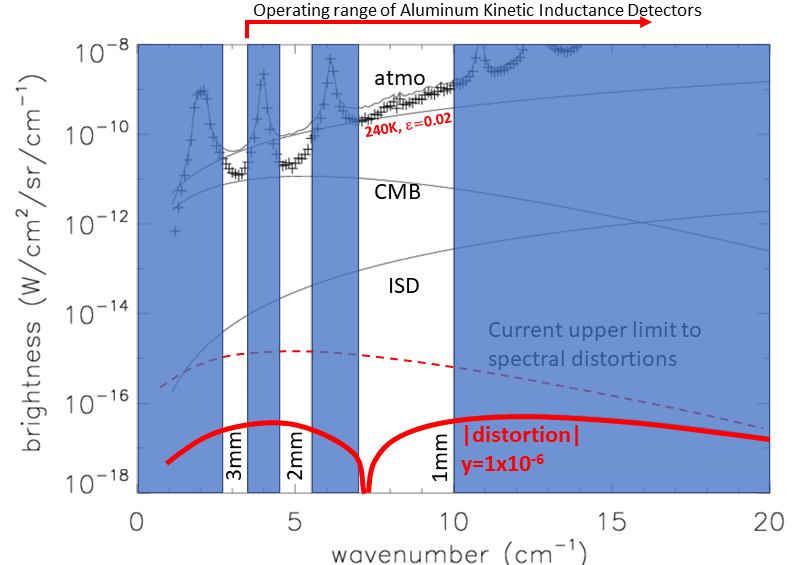
Figure 5: comparison
between the brightness of the atmosphere, the CMB,
interstellar dust, and y spectral distortion (modulus).
|
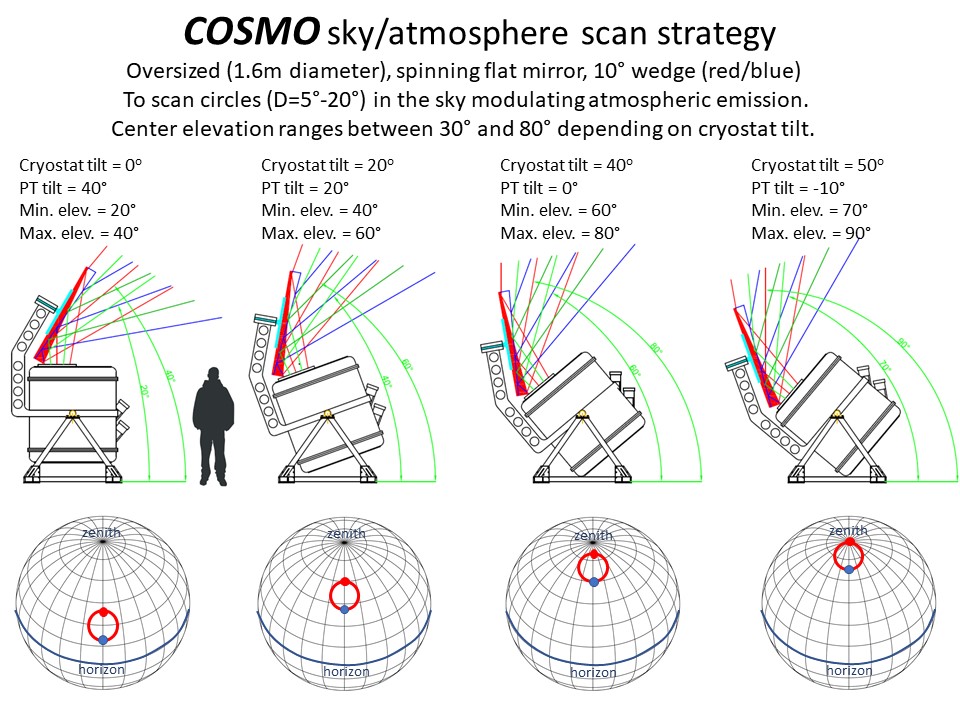
The sky scan is obtained
by means of a spinning wedge mirror as
illustrated in figure 6 below.
|
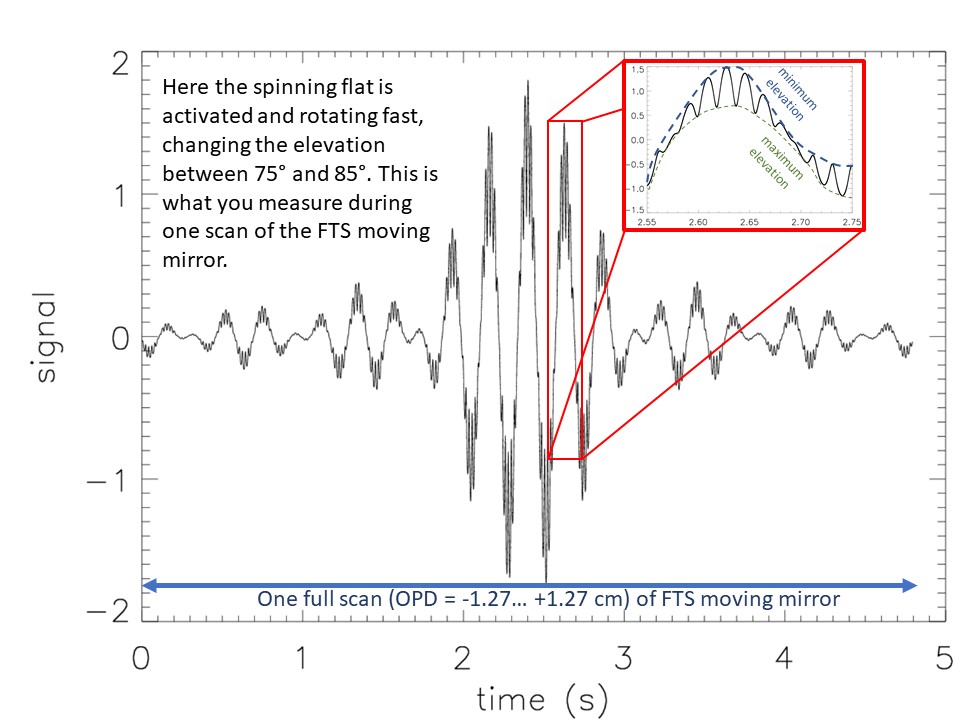
The simulation of the
resulting interferogram is shown in figure 7 below.
|
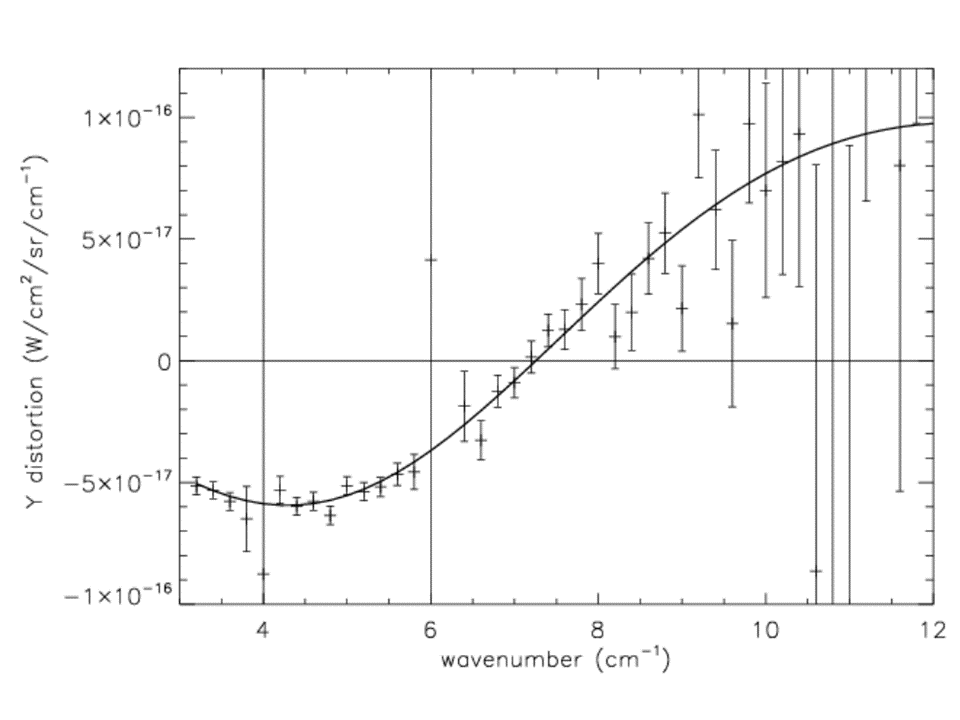
The simulation of a best fit procedure
assuming a cosec law for the sky- dip data
produces the following estimate of the monopole component
(figure 8 below): the error bars are for 1 year of
measurements with the COSMO instrument, assuming
correlated atmospheric noise and NEP around 10-16
W/sqrt(Hz) for each of the 30 detectors in the focal plane
array. The y distortion (assumed at 1.8x10⁻⁶)
is detected with high significance.
|
We are currently working
hard to build the instrument.
The experiment is scheduled to start data taking in 2026.
|
|
back to main page
|